Adequacy Gaps Mean More Money…for Everyone?
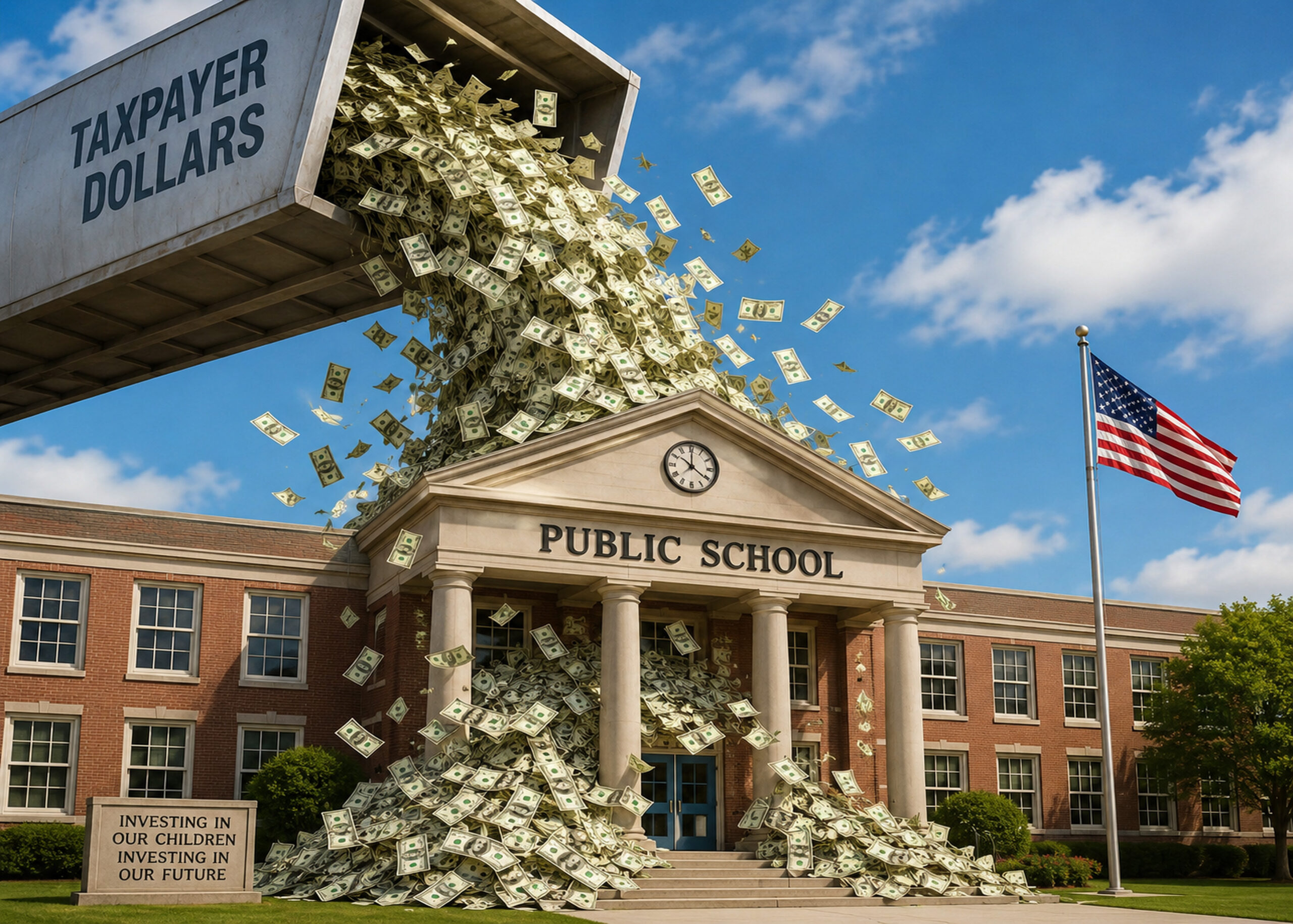
Pennsylvania has 500 school districts that strive to educate the children of this Commonwealth to the standards set by the Pennsylvania State Board of Education in conjunction with the U.S. Department of Education.
Each district is unique in its composition of financial resources, educator experience and competency, student populations, etc. State elected leaders try to accommodate the needs of these diverse districts to bring about a uniform result – proficient students. How do they do that? Tax dollars! Just how much is needed to accomplish the goal?
Adequacy Target

Legislators and the governor have used various allocation methods for state funding over the years. Based on a 2023 Commonwealth Court ruling in William Penn School District et al. v. Pennsylvania Department of Education et al. the bipartisan Basic Education Funding Commission (BEFC) was convened to equalize the resources apportioned among districts. The commission devised a new funding formula to comply with the court order which required “every student receive a meaningful opportunity to succeed academically, socially, and civically, which requires that all students have access to a comprehensive, effective, and contemporary system of public education.”
In January 2024 the BEFC completed its majority report and sent it to the legislature after an 8-to-7 vote. The report established that students could be educated appropriately if each school district spent $13,704 per student. This figure was derived by identifying successful districts and examining the amount spent per learner. That number was applied statewide and became the “Adequacy Target” for financial allocation to each district.
Everything that follows stems from the figure provided by the BEFC: $13,704 as the amount needed to spend per pupil to provide a good education. Yet, according to the Commonwealth Foundation’s education transparency website, OpenPAGov.org, the average amount spent by school districts to educate one student in 2023 was $22,123. That is more than one and half times the amount the commission deemed necessary.
Everyone knows that numbers can be manipulated to corroborate just about any thesis. Why might it have been done with the BEFC?
Funding the Adequacy Gap
Each district is funded by local, state, and federal dollars. The difference between what a school district spends from all sources per student and the Adequacy Target is termed the “Adequacy Gap.”
The BEFC identified 387 of the 500 PA school districts, or 77%, as having an Adequacy gap. The commission believes that gap should be filled by a “State Adequacy Supplement” or by local funding sources, i.e. increased property taxes. However, since some districts already have very high property taxes, the BEFC suggested that Pennsylvania provide those districts with a “Tax Equity Supplement” to protect property owners from additional tax increases.
Act 55 of 2024 established the Ready-to-Learn Block Grant structure for education funding. It includes:
- Ready-to-Learn foundation (hold-harmless provision requires that the budgeted amount remains the same as the prior fiscal year or increase);
- Adequacy Supplement;
- Tax Equity Supplement
For more on the hold-harmless provision and what it means, you can refer to a prior article, “Is Tax Reform Possible?”
Everyone Gets Some

On November 12, 2025 in Act 47 of 2025, the legislature amended Act 55 of 2024 to include a “minimum allocation supplement.” Essentially, if a school district did not receive at least $50,000 through the Adequacy Supplement, the Tax Equity Supplement, or a combination of the two, then it would receive a $50,000 Minimum Allocation Supplement. This supplement, titled Minimum Adequacy Supplement, was included in Pennsylvania’s 2025-2026 budget and 2026-2027 budget.
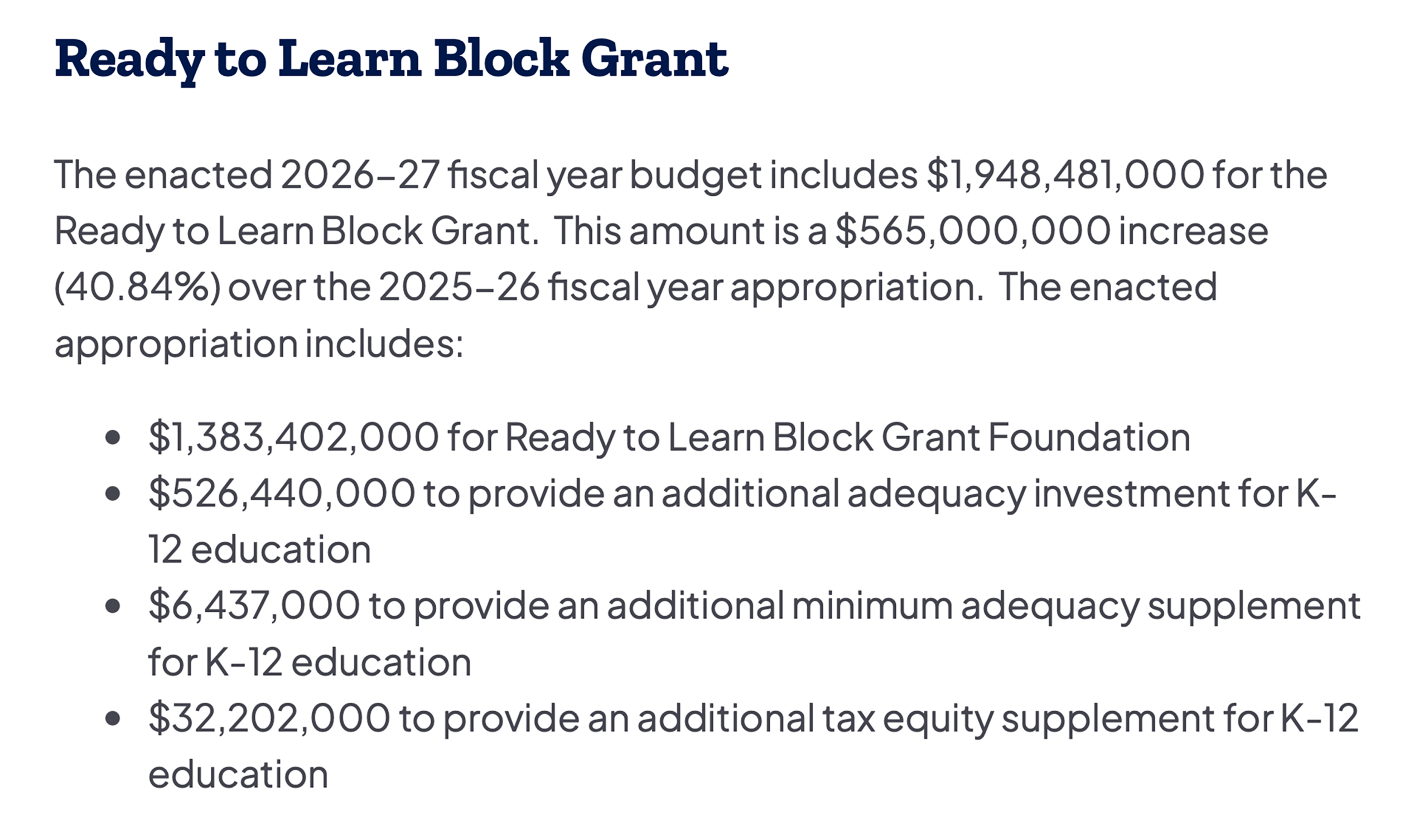
Was the goal really to provide more funding to poorer districts while ensuring that every district received at least as much as it did the previous year? If so, then why did the legislature and governor believe it necessary to provide more to every school district in the form of a $50,000 minimum supplemental grant
Remember, the $1.948 billion in Ready-to-Learn Block Grants is already a supplement to help districts achieve the Adequacy Target. That is in addition to the $8.320 billion appropriated for Basic Education Funding. Why allocate even more when the district already meets the Adequacy Target?
Pennsylvania’s total 2026-27 budget is $50.8 billion. Total education funding, according to Department of Education figures, is $20.6 billion, or approximately 40% of the state spending.
Each year the state budget increases and each year the allocation to education increases. We are told it’s for the children – to give them the skills and tools to be successful in this changing world. We are told that schools are underfunded and that students deserve smartboards, iPads, laptops, and every new piece of technology invented.
What we aren’t being told is that under the hold-harmless provision of PA law, once funding levels are set for education, they can never decrease in subsequent years. Education funding can only remain the same or increase.
What we aren’t being told is that only 50% of Pennsylvania 8th grade students are proficient in English Language Arts.
What we aren’t being told is that only 31% of Pennsylvania 8th grade students are proficient in Math.
So, why allocate more money to districts when they don’t need it? Why not? Future legislatures won’t be able to take the funding away, so why not allow everyone to get some? It might help some districts teach children to read or do math. There’s no guarantee, since additional funding hasn’t really helped in the past. But it can’t hurt, right?
Bottom line…
Until the legislature and governor amend or remove the hold-harmless provision of the law with respect to education funding, and until education funding is tied to educational accomplishments, the Pennsylvania taxpayers have reason to feel like suckers!
Taxpayers deserve more from their elected officials than emotional manipulation. Learn the facts. Demand better from Harrisburg.
As the Constitutional Convention ended in 1787, Benjamin Franklin was asked if the delegates produced a monarchy or a republic. Franklin replied, “A republic, if you can keep it.”
We are trying to keep this republic that we love and hold our representatives accountable to the people. Join us in that mission and share this Update with your contacts!